A triad against
the baseline.
16 triads. One reference. A frozen 1.10 gain target, with equal field resources and uncertainty required.
INDEPENDENT PROPULSION RESEARCH
Can three magnetic sources transfer more momentum than one? Exploring plasma, field geometry, and the evidence a propulsion concept needs.
Open the PIC Observatory See the full spacecraft conceptA bigger magnetic footprint.
But does it do more?
DAIS studies how a flowing plasma interacts with magnetic sources. The primary hypothesis: a co-axial triad can transfer at least 10% more axial momentum than a single source at equal imposed magnetic-field resources.
The current work uses reduced-mass, two-dimensional electromagnetic particle-in-cell screening in WarpX. Reservoir stability comes first. Single-source convergence and a matched triad comparison follow only after the required gates pass.
Read the research briefsExplore the geometry behind the question.
Then see how the actual tests are structured.
This model is an artistic interpretation.
Explore an artistic propulsion assembly. The research compares a single source with a triad at equal imposed magnetic-field energy, then measures their momentum transfer.
Concept visualization. Not a physics simulation or measured performance.
One primary comparison. An exploratory extension.
A validation protocol that keeps both accountable.
Research status · The stored reservoir gate remains unvalidated. No validated propulsion gain or mission-time prediction is established by this work.
16 triads. One reference. A frozen 1.10 gain target, with equal field resources and uncertainty required.
Dynamic fields and reduced particle models explore conditioning. System efficiency and thrust remain unvalidated.
Particle accounting, charge balance, local thermal stability, and energy closure before any topology ranking.
The infographic imagines a flow-through spacecraft.
Beamed energy supplies power. External material supplies reaction mass. Each stage needs its own validation.
Harvest solar energy and transmit a focused beam.
Convert received energy into usable spacecraft power.
Collect external material and ionize it where needed.
Investigate whether controlled fields can organize the flow.
Supply energy to accelerate the charged particles.
Direct the plasma exhaust and account for source reaction.
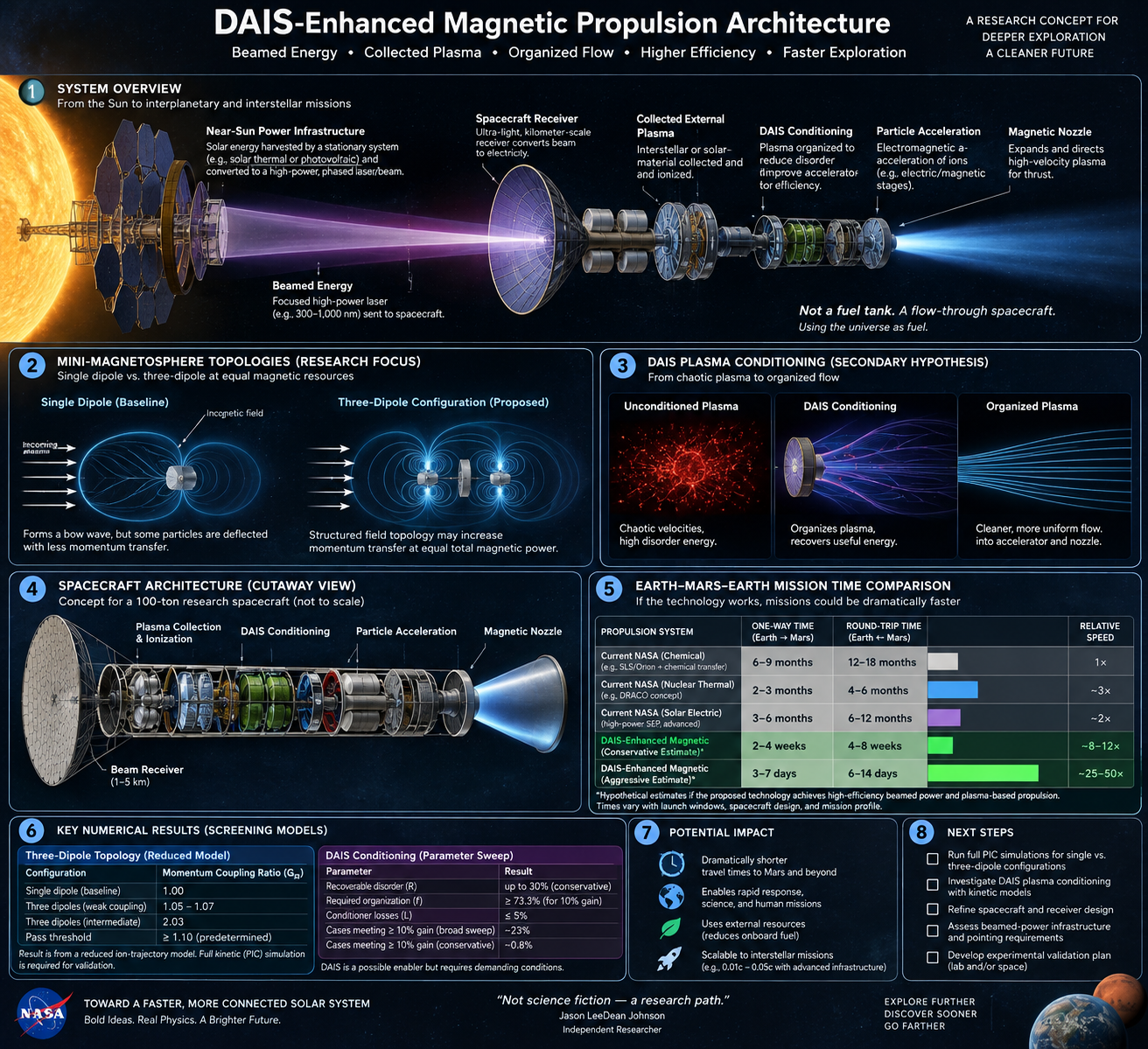
The present PIC model addresses the single-source versus three-source interaction in panel 2. It does not simulate the receiver, collection, conditioning, powered acceleration, nozzle, or a mission trajectory. The image’s 2.03 gain and conditioning sweep numbers arrived without supporting code or data and are not calibration targets. Its faster Mars journeys remain hypothetical. Equal magnetic-field resources in the study must not be read as equal electrical power.
A sequence of scientific prerequisites.
Missing evidence keeps the next comparison locked.
Close particle and energy budgets. Check charge, local thermal variance, and drift across independent seeds and numerical refinements. Require at least ten flow crossings.
NOT VALIDATED
Freeze the passing reservoir. Demonstrate steady and converged momentum transfer to one source before using its impulse as the comparison denominator.
BLOCKED BY TEST 0
Compare matched source-field resources and physical intervals. Report the gain ratio with uncertainty. A point estimate of GR ≥ 1.10 alone cannot establish the claim.
COMPARISON NOT AUTHORIZED BY GATE
Static summary of the repository’s recorded state, not a live campaign feed. The observatory explains these steps and can inspect a saved JSON report locally.
Based on the project’s 2D kinetic study, locked TEST 0 protocol, stored reservoir gate, and DAIS-DYNAMIC development report. These public summaries accompany the concept; research source files and raw results are not part of this website.
THE NEXT STEP IS A BETTER TEST.
PLASMA. BOUNDARIES. EVIDENCE.Four ways to explore the physics. One standard of evidence.
Review the validation path